Studio Notes · 20 November 2026
The Clues in a Glaze: Reading Dehua Export Porcelain in Lisbon
What two blue-and-white fragments from Lisbon can tell us about where they were made, and what a star-shaped mark cannot prove on its own.
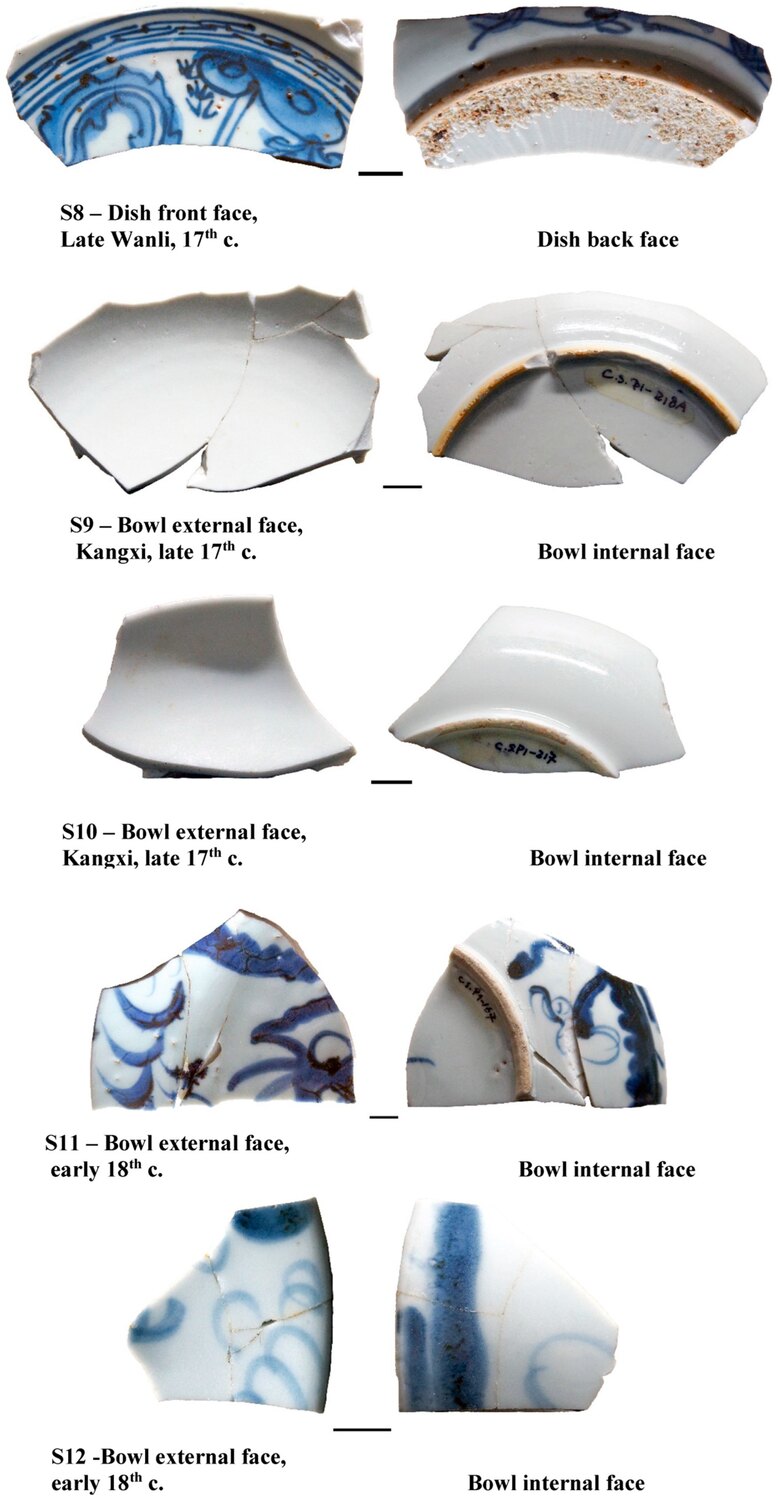
A dark blue mark can look different once you stop reading it as decoration. In a study of Chinese porcelain fragments excavated at Lisbon’s Santana Convent, some dark patches spread into fine, radiating points under magnification. The pattern is small enough to miss on a shelf, yet it gave researchers a reason to compare two blue-and-white fragments with porcelain from Dehua.
Start with the mark, not the name
Luís Filipe Vieira Ferreira and colleagues compared the Lisbon material with porcelain of known provenance from the Jingdezhen, Anxi and Dehua kiln systems. They examined the surfaces under magnification and used several analytical methods to study pigments, glaze and minerals. Radiating marks were particularly frequent in their Dehua material. For two Lisbon fragments, that resemblance was consistent with a Dehua origin. It was not an identification based on shape alone.
This difference matters when looking at an unlabelled piece. A visible feature can tell us what is worth comparing. It cannot tell us, by itself, whether the same feature also occurs elsewhere. The useful question is not ‘Does this look like Dehua?’ but ‘What else would we need to see, and what should we compare it with?’
Dehua beyond the white figure
For readers who know Dehua chiefly through white sculptures, the blue-and-white fragments offer a different starting point. A report on the Dalongkou kiln excavation in Dehua describes both white and blue-and-white wares, alongside kiln furniture. That is evidence for the range of wares made at Dehua. It is not evidence that these specific fragments came from Dalongkou, nor does the site where they were recovered tell us which workshop or route brought them to Lisbon.
A slower way to read a surface
Try looking at a decorated vessel twice. First follow the painted line as part of the design. Then look towards its edge: where does the colour remain sharp, and where does it spread? Keep the description separate from the explanation. That second look will not authenticate a piece, but it gives a collector, potter or museum visitor a better question to ask of it.
Sources
Ferreira et al., Coatings (2026): the Lisbon porcelain study
Dehua County Government: the Dalongkou kiln excavation report (in Chinese)