Journal / Materials & Making
The Quiet Surface of Hand-Impressed Porcelain
How impressed patterns give porcelain depth: a closer look at moulded detail, changing light and the relationship between surface and form.
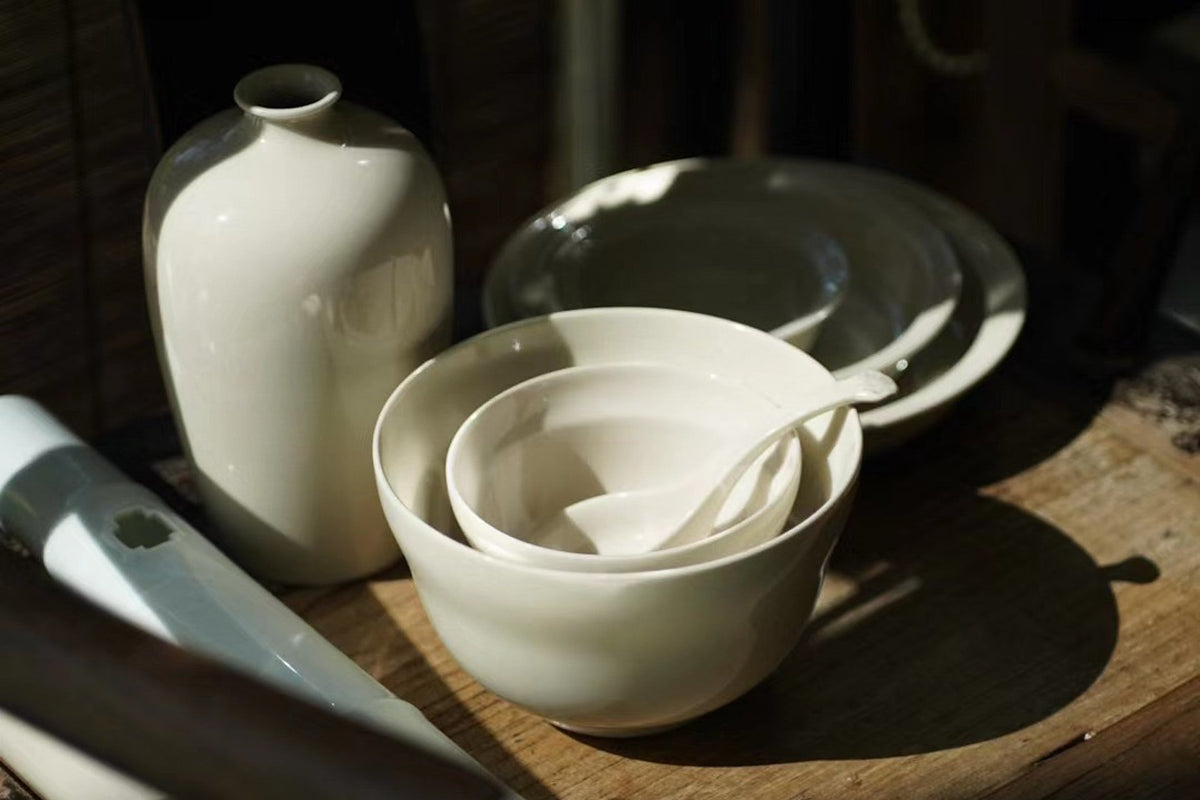
A pattern on porcelain can be easy to miss until the light moves. A shallow line becomes a shadow; a raised edge catches a narrow highlight. Looking at an impressed surface is an exercise in noticing these small changes, especially when the body and decoration share a pale colour.
The Best Ceramics craft archive describes a process in which patterned moulds or plates are pressed against clay that is still workable. The contact creates relief or texture before the piece is dried and fired. The accompanying workshop sequence offers a brief view of the hand and tool meeting the clay.
Pattern with depth
An impression has a physical dimension. Its lines belong to the surface of the object, and their appearance changes with the direction of the light. A motif that reads clearly from one angle may soften from another. That movement gives even a repeated pattern a changing presence.
It is useful to look at both the detailed surface and the complete vessel. Decoration can guide the eye around a curve, but it also sits within a larger arrangement of rim, body and foot. A successful encounter with the object allows attention to move between these scales.

What the making sequence shows
The visible action is straightforward: pressure transfers a pattern into a receptive surface. Judgement enters through the handling of the clay, the positioning of the tool and the relationship between the decoration and the surrounding form. The short sequence is a useful beginning, rather than a complete technical lesson.
Drying, glazing and firing also contribute to the final object. Particular recipes and firing schedules vary, so one example should not be read as a universal specification for all Dehua porcelain. Likewise, surface variation alone cannot tell a viewer everything about how a piece was made.
A way of looking
Start with a broad view, then move closer. Follow the edges of a motif and see where they become sharp or soft. Notice how a shallow depression changes beside a raised line. Return to the whole vessel and consider whether the pattern draws attention to its proportions or gives it a different rhythm.
This kind of looking suits a quiet gallery setting. It makes space for the material to reveal itself gradually, without needing a dramatic colour or an elaborate description. The object offers enough to work with.
The images here come from the Best Ceramics introduction to impressed porcelain. The still photograph is an accompanying teaware image; the animated sequence shows the making action. Together they offer two complementary ways into a subject that rewards patient observation.